
Heliodora's substack
A brief introduction: astrology, archaeology, the divine and the personal

Imbolc feels like an appropriate time for the germination of something new, so I thought I’d begin by introducing my profile here, what underlies it, and why it represents me. In this Substack, I want to share reflections on some of my main interests like astrology, magic, divination and esoteric history, and at the same offer something personal and authentic, so here I experiment with combining the two.
Heliodora is the name of the recently discovered earliest known female astrologer. She is commemorated in a funerary stele of the 2nd-3rd Century AD, found at a site called Ternouthis, in the Egyptian Delta. Endowed with the epithet ‘mathematikos’ (mathematician) we know that Heliodora must have been a skilled calculator and interpreter of the stars in her own right: in the ancient world, mathematical skills and astronomy were a pre-requisite for the skill of divinatory reading of the stars.
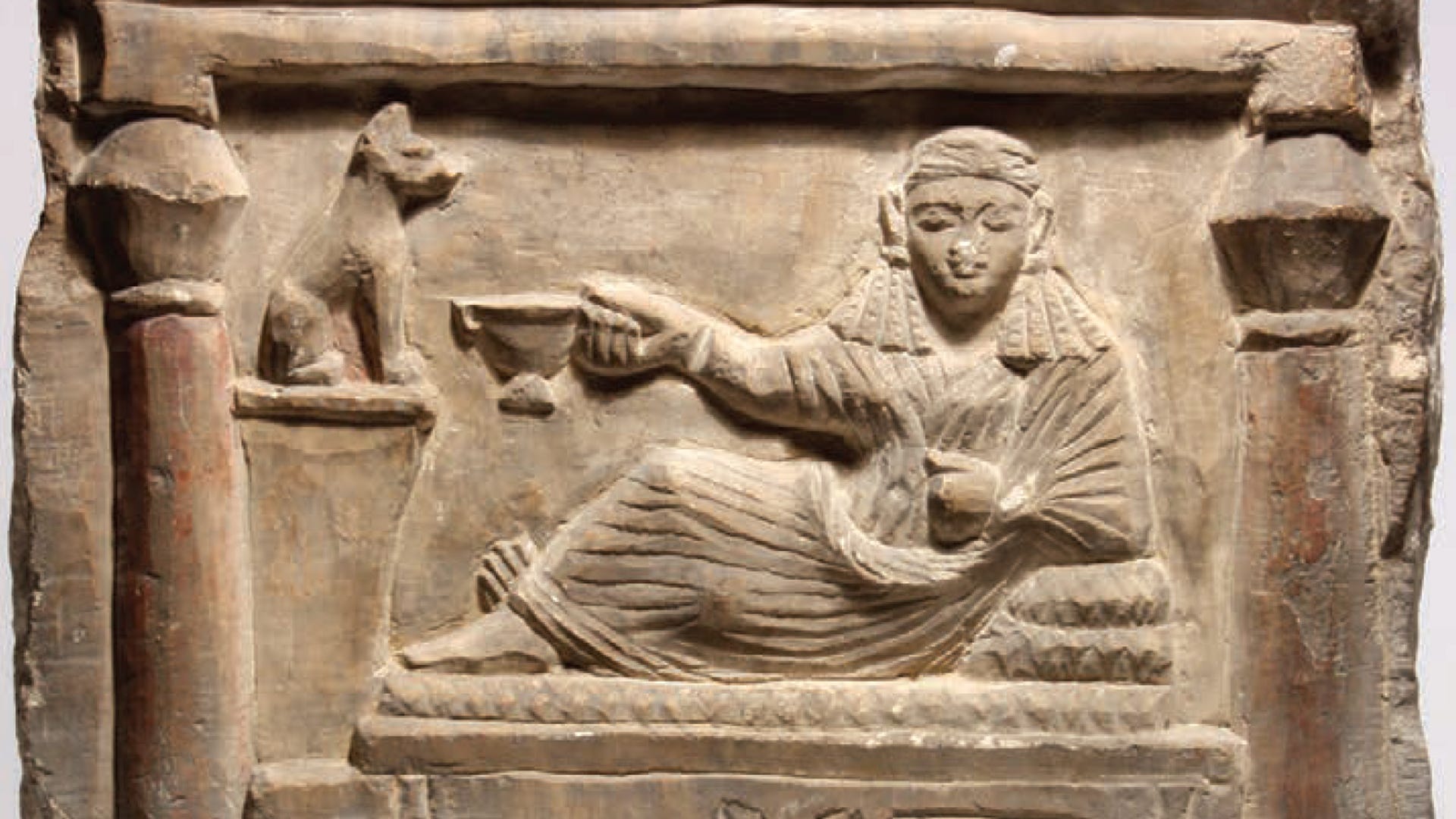
Of the c.700 stelae known from this site, it seems it was relatively rare for them to comment on the person’s profession, perhaps reflecting the fact that Heliodora’s was remarkable. The inscription on the stele, though, was quite unusual in a number of ways. More fundamentally, since there are no other known references to a woman using the term ‘mathematikos’ in the period, she is likely to have been a generally unusual, perhaps quite exceptional, person.
She appears to have been a single, 52-year old professional woman, having seen her first Chiron return before she died (although she could not have known this). I often wonder what her life was like. She likely had some considerable advantages by birth, given her profession and her apparent freedom to choose not to marry. Though described as a virgin, she could potentially have had a female companion that she lived with, but who was overlooked when her brother commissioned the stele.
Here I admit to speculation based on the epithet ‘brother-loving’ and the frequent blind spot of patriarchal cultures for lesbian relationships; but, of course, she could just as easily have been celibate for religious reasons, or asexual, or didn’t find a male companion she was compatible with due to her status and learnedness. For what it’s worth, in my ‘head canon’ I imagine she lived with her wife and they went through their mid-life transits together.
The name Heliodora is of Greek origin, and translates as something like ‘gift of the Sun’. Like the name Helen, it derives from ‘Helios’, both the word for the Sun and the name of a Sun god, which reflects the divinity of the Sun itself. Sun worship is common across many cultures, although it does not always dominate over lunar worship as it does in many modern western cultures. Although I focus here on the Solar, I will discuss Lunar and Solilunar themes in more depth elsewhere.
The Sun in astrology represents our life path, our growth, development and self-actualisation - our destiny (as opposed to fate, which is more signified by the Moon, its Nodes, and the Lot of Fortune). The Sun takes a more linear, evolutionary path in the unfolding of our inner life, as it moves one degree per year around the zodiac using the technique of secondary progression. Of course, the Sun’s role is not only linear, any more than it is truly stationary. It is interwoven with the Moon, whose cycles create the familiar monthly lunar phases (and 28-yearly cycles by secondary progression), and we take the Sun’s annual cycle almost for granted, during which it creates seasonal change and illuminates each sector of our birth chart, one by one.
But the natal position of our Sun, and its gradual shift by progression through perhaps three or four signs in total in our life, marks an important dimension of our personality’s long-term evolution. This is why not everyone resonates with their Sun Sign - not only because it is a part of the birth chart, but because we have to develop its qualities in our life. Jung associated the Sun with the Self, a centre of the psyche and a key element in the process of individuation, by which a person becomes a whole and integrated individual with self-knowledge.
Here I turn to my own self. At birth, I was given the name Helen, possibly meaning ‘bright one’. On that day, the Sun was in Aries, the sign of its exaltation, where it can comfortably express its qualities. For me, it is in the fourth house, which means that home and family are very important to me. However, I have found that the fourth house also has to do with emotional security. It sits at the foundation of our self and consciousness. Because it squares the Ascendant/first house, it is considered an ‘angular’ house, and planets there are influential. My journey through life therefore includes exploring those deeper layers of my consciousness, finding and building emotional security within. A trine with Jupiter connects this path with spiritual learning, higher education, and curiosity about the cosmological nature of the universe, and a semisquare to Chiron links it subtly with my personal healing journey.
The fourth house also has to do with ancestry and origins, and I have a Saturn-ruled Ascendant - so naturally I have always been drawn to the study of the past. In fact, I was an archaeologist for ten years. Decades before that, as a child I first wanted to become an archaeologist, inspired by ancient Egypt. I used to spend time alone in the local library, reading the Encyclopaedia Britannica, and I remember being deeply drawn to Egypt. Knowing nothing then of colonialism, I was entranced by the magic of the culture as seen in its material remains, its beautiful aesthetics, and the fascinating cosmology implied by half-animal gods occupying the dynamic night sky.
When Heliodora’s stele was published a few years ago, I had not yet found my way back to astrology, tarot and magic after a 15-year spell in a world of materialistic, rationalistic empiricism. But Pluto had begun applying to the degree of my Ascendant, and a chain of life-altering transits and events had begun. This would lead to me, in my late 30s-early 40s, with what felt like my life lying in pieces around me, searching in the dark for a way to comprehend what had happened to me and what it meant, stumbling upon the revival of Hellenistic astrology, including its important connections to Egypt, and eventually hearing of Heliodora via the Astrology Podcast.
This is why I chose the name of Heliodora to start sharing my journey: it somehow embodies and conveys something of my name, my interests, my identity, my education, my character, my predispositions, and my journey. It rather felt like it chose me. I hope that this slightly meandering story will serve to introduce my purpose here: to articulate and share a journey of learning and healing, one that interweaves seeking new knowledge and skills - ancient, modern and timeless - with reflections about myself, my past and my inner world.
Really enjoyable read. I also for the most part abandoned astrology and tarot for a good 15 years and found myself drawn back in. For similar reasons.
I also have always thought of the fourth house being where we draw a sense of security and safety. Very Cancerian issues. And with Saturn sitting on my fourth house in Pisces, it's been a journey. lol. 😂
I have a Substack question for you. Sometimes I see posts that have a nice little icon and subscribe button at the very top, like on this post, but I haven’t figured out how to do it on mine. Would you lend a hand?